What We Are Measuring
Two metrics from the heart rate signal tell us something meaningful about the state of the autonomic nervous system — the background control system that governs stress, recovery and resilience.
RMSSD — Root Mean Square of Successive Differences
RMSSD measures the millisecond-level variation between consecutive heartbeats. Contrary to what might be expected, a higher RMSSD is better — it reflects strong parasympathetic (vagal) tone, meaning the nervous system has good flexibility and recovery capacity. A low RMSSD is associated with stress, fatigue and poor recovery.
Normal resting RMSSD varies widely between individuals — roughly 20–65ms for healthy adults — and declines naturally with age. What matters most is your own baseline and how it responds to different states.
Cardiac Coherence
Coherence is a different measure. It describes whether the heart rhythm is oscillating in a smooth, ordered pattern at a specific frequency — around 0.1 Hz (approximately 6 cycles per minute, or a 5-second inhale followed by a 5-second exhale). When this happens, the heart, nervous system and respiratory system synchronise — a state associated with reduced cortisol, improved cognitive function and emotional regulation.
The coherence score used here is calculated using a Discrete Fourier Transform over the last 30 RR intervals, focusing on the 0.06–0.14 Hz frequency window (the HeartMath coherence band). It is also constrained by RMSSD — genuine high coherence cannot occur without the underlying vagal tone to support it.
Three-State Comparison
The following readings were recorded using the For Humanity Kaleidoscope HRV tool with a CooSpo H6M chest strap connected via Web Bluetooth on Chrome desktop. Each state was maintained for at least two minutes before reading to allow stabilisation.
| State | BPM | RMSSD | Coherence | Notes |
|---|---|---|---|---|
| Resting | 51–53 | 35–41ms | Normal unguided breathing. RMSSD varies naturally at rest — this range is expected and healthy. | |
| 4·7·8 Relaxation | 51 | 58ms | RMSSD elevated significantly above rest — strong vagal activation. Coherence low by design: 4·7·8 cycle frequency (0.053 Hz) falls below the cardiac resonance window. | |
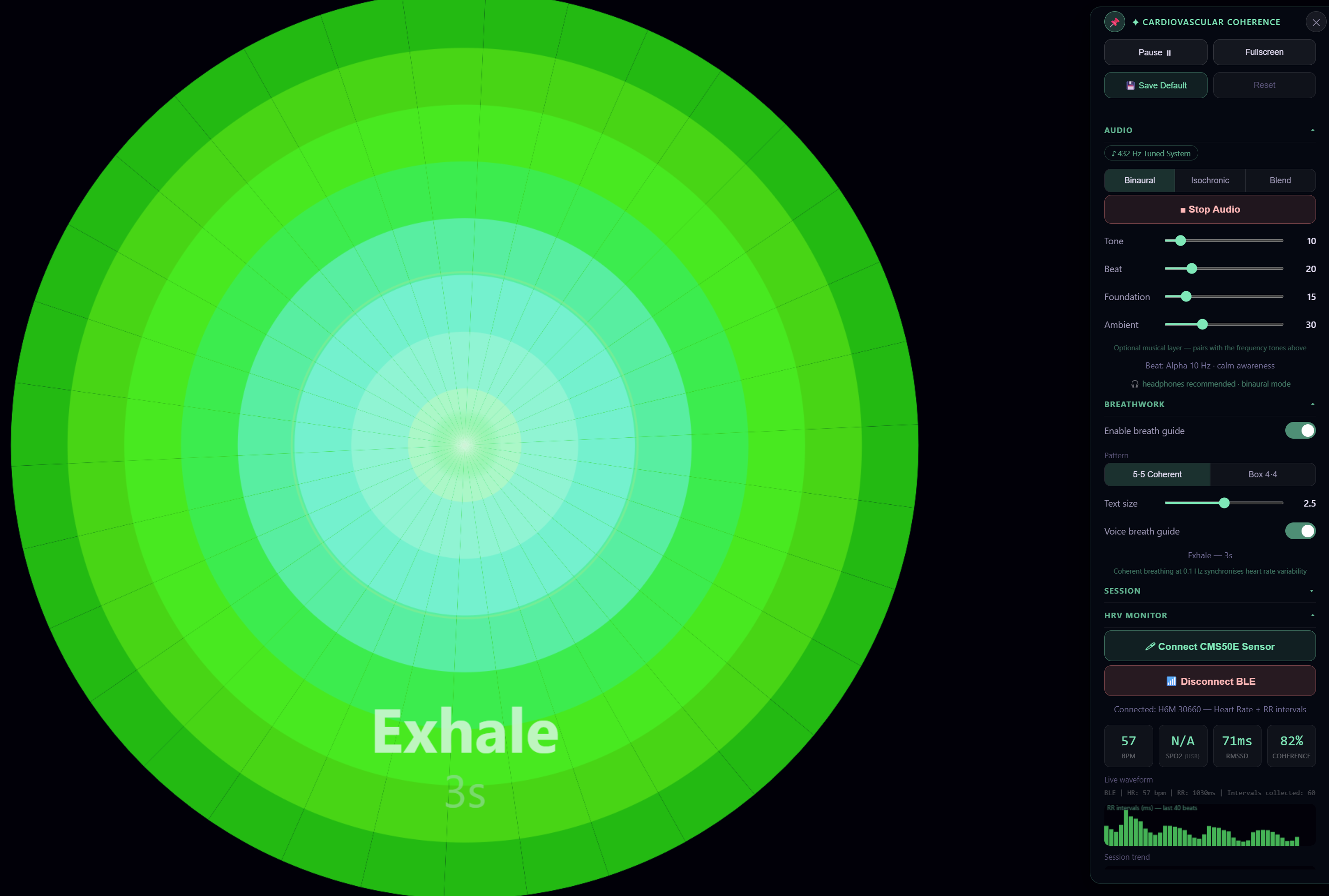
| 5·5 Coherent Breathing | 57 | 71ms | Both RMSSD and coherence elevated. The 5·5 pattern drives the heart rhythm at 0.1 Hz — the baroreflex resonance frequency — producing both high vagal tone and a synchronised rhythm. |
The following screenshots were captured directly from the For Humanity Kaleidoscope HRV tool during the test session, showing the live panel readings at rest:
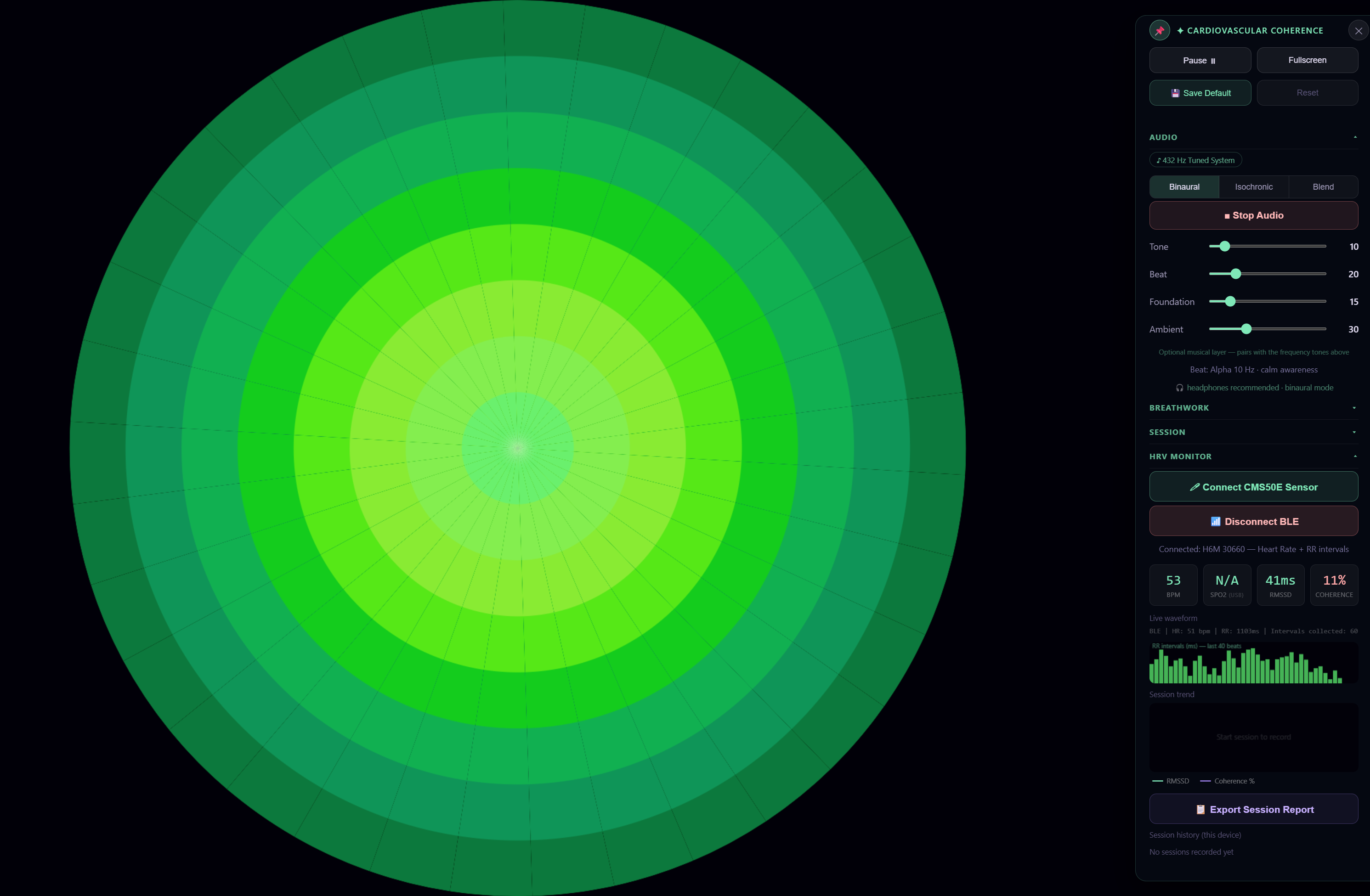
Normal resting breathing, no guidance
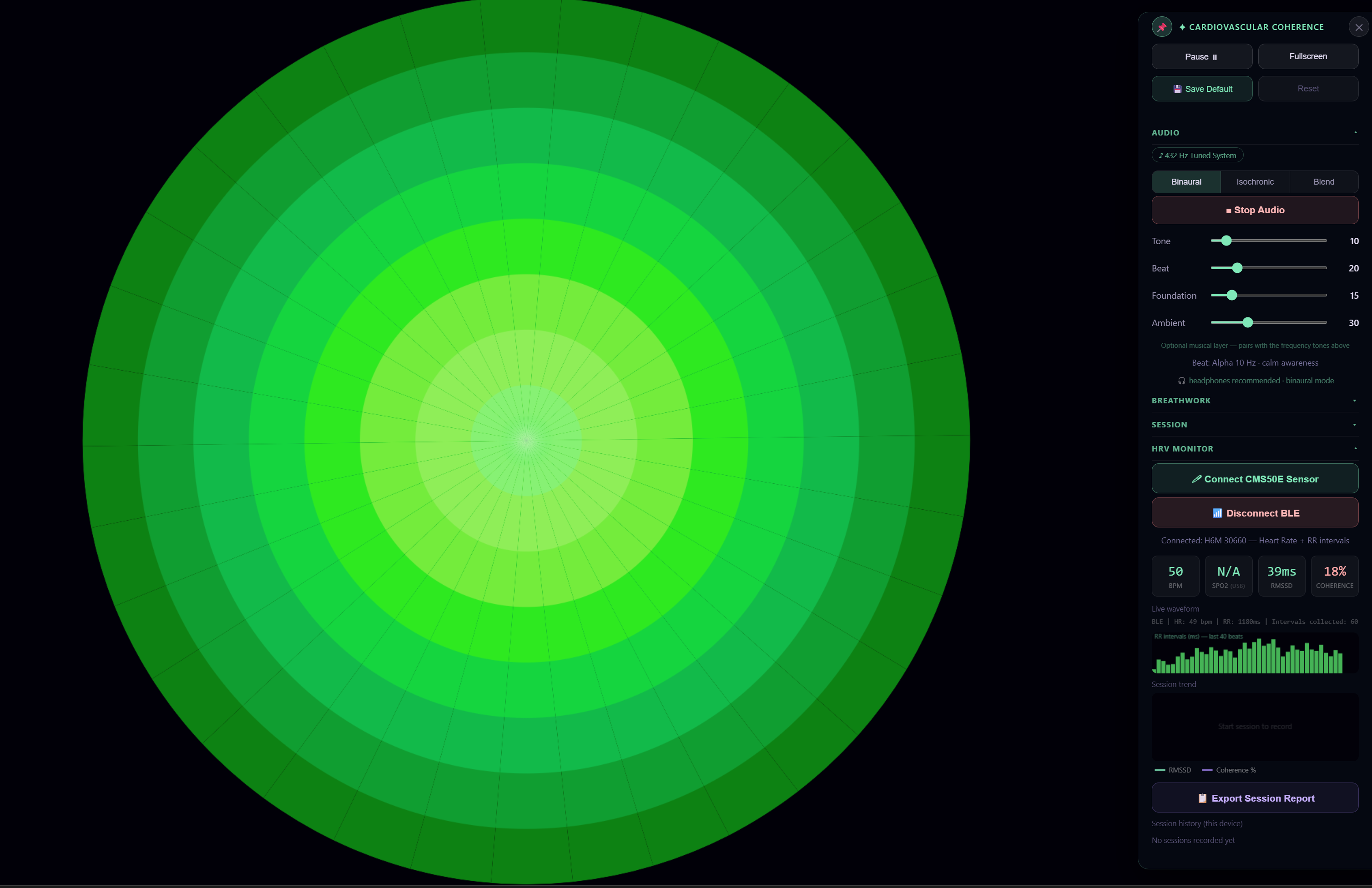
Natural variation at rest — coherence fluctuates within range
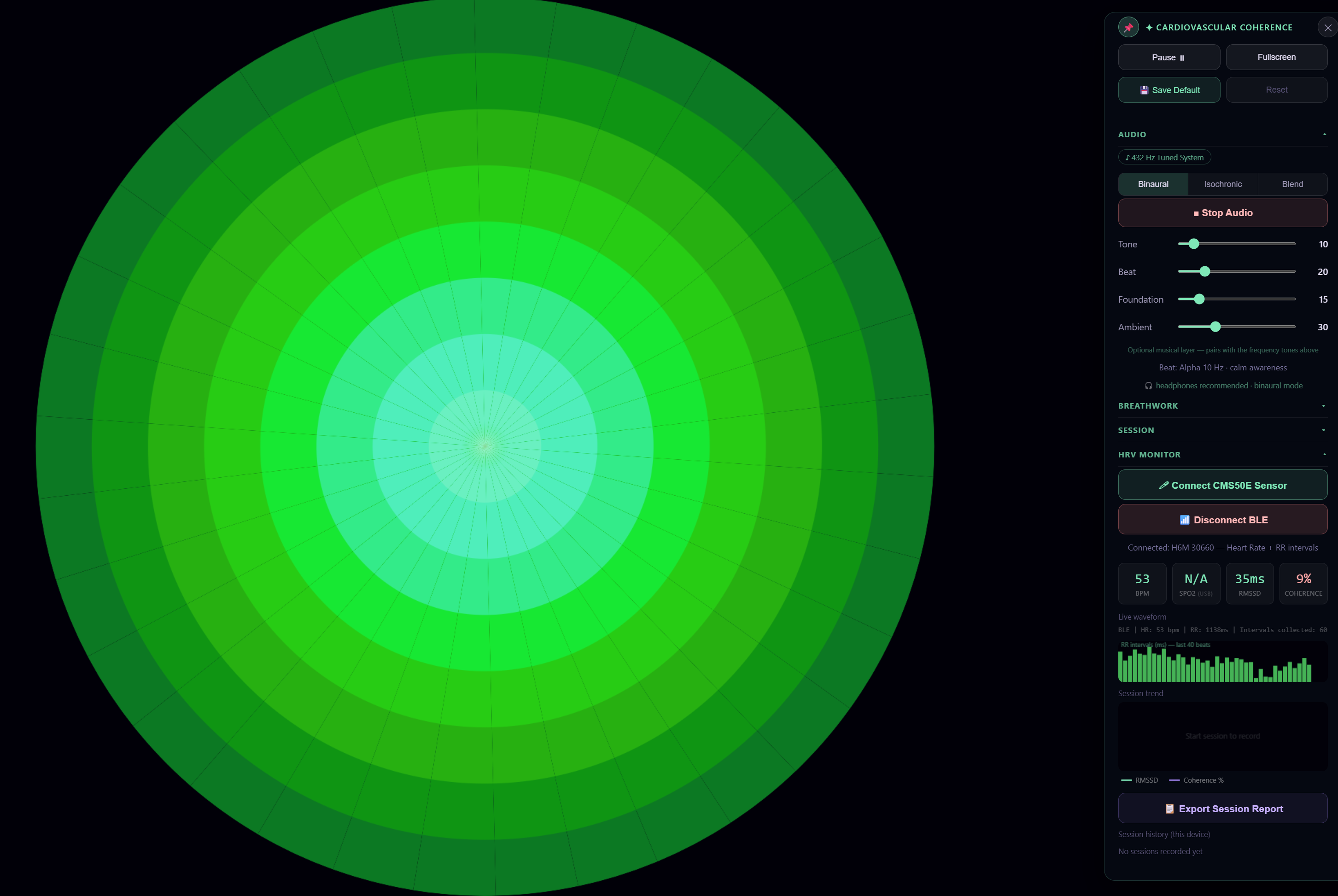
Lower end of resting range — normal variation
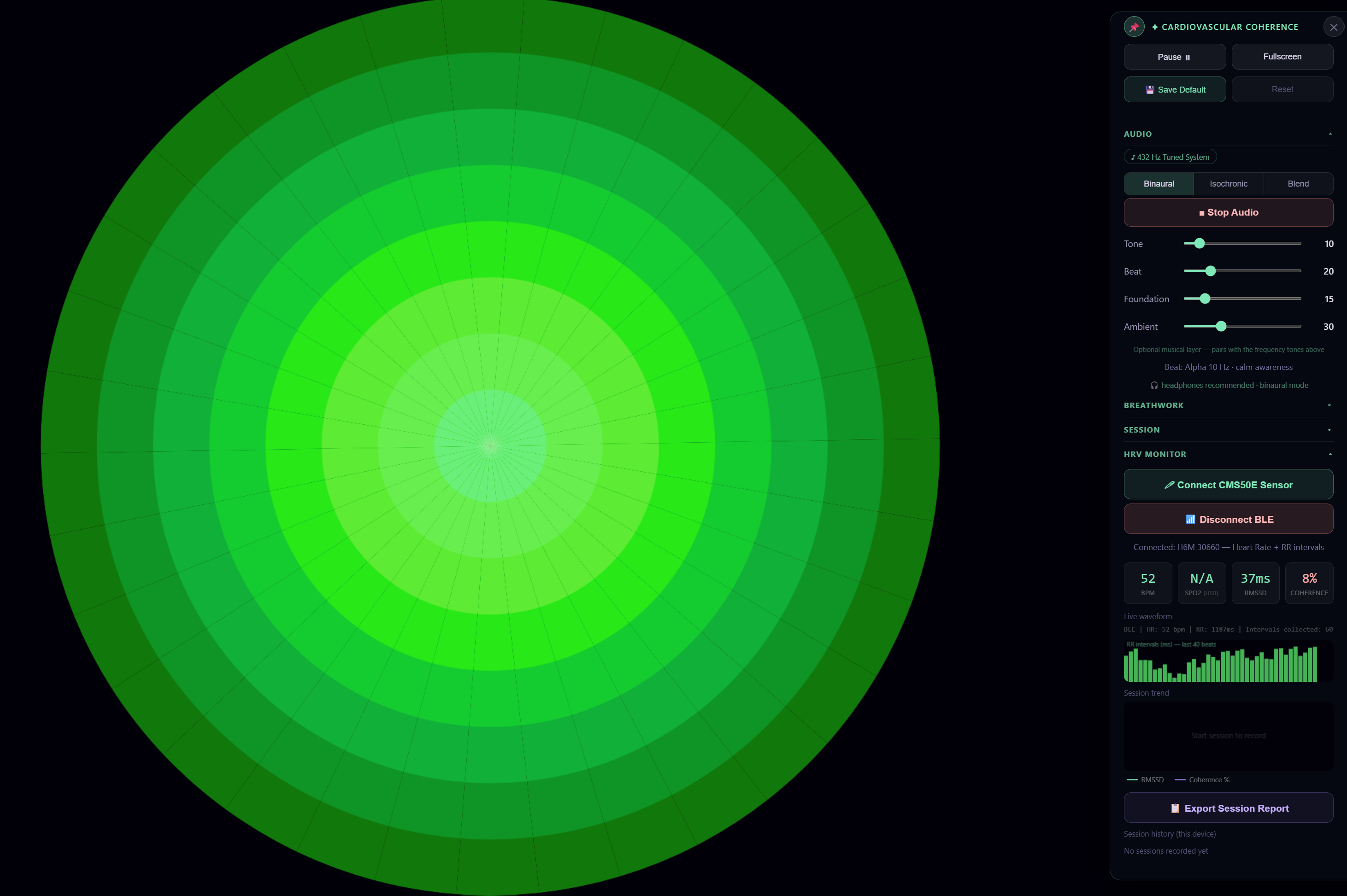
Consistent with previous resting readings
The following screenshot was captured during active 5·5 coherent breathing with the breath guide enabled, showing the peak reading achieved:
What the Scores Mean
The three-tier model above is adapted from HeartMath Institute's published coherence categories. The key insight is that high coherence is not a resting state — it requires active engagement with a specific breathing rhythm. The value of regular coherent breathing practice is not the score during the session, but the cumulative effect on baseline RMSSD and autonomic flexibility over time.
Equipment and Method
Sensor
CooSpo H6M chest strap — broadcasts via Bluetooth Low Energy (BLE), Heart Rate Service (0x180D), Heart Rate Measurement characteristic (0x2A37) with RR intervals. Chest straps measure the cardiac electrical signal directly, giving highly accurate beat-to-beat timing. This is the same method used in clinical and research settings.
Connection
Web Bluetooth API via Chrome on desktop. The For Humanity HRV tool connects directly to the sensor in the browser — no app, no cloud, no data transmission. All processing happens locally on your device.
Coherence calculation
A Discrete Fourier Transform is computed over the last 30 RR intervals. Power in the 0.06–0.14 Hz band (the HeartMath coherence window, centred on 0.1 Hz) is expressed as a proportion of total spectral power. The score is additionally constrained by RMSSD — high coherence requires the underlying vagal tone to support it physiologically. This prevents high scores from frequency artefacts when HRV is genuinely low.
RMSSD calculation
Standard Task Force method — square root of the mean of squared successive differences between RR intervals, computed across all collected intervals. Updated in real time as new beats are received from the sensor.
Key References
- Task Force of the European Society of Cardiology and the North American Society of Pacing and Electrophysiology (1996). Heart rate variability: Standards of measurement, physiological interpretation, and clinical use. Circulation, 93(5), 1043–1065. — The foundational standard defining RMSSD, LF/HF bands and frequency-domain HRV methodology.
- McCraty R, Atkinson M, Tomasino D, Bradley RT (2009). The coherent heart: heart-brain interactions, psychophysiological coherence, and the emergence of system-wide order. Integral Review, 5(2), 10–115. — HeartMath Institute's primary coherence research paper, defining the coherence scoring model and three-tier classification.
- McCraty R (2016). Science of the Heart, Volume 2: Exploring the Role of the Heart in Human Performance. HeartMath Institute Research Center. — Comprehensive review of cardiac coherence research including carry-over effects and cumulative practice benefits.
- Lehrer PM, Gevirtz R (2014). Heart rate variability biofeedback: how and why does it work? Frontiers in Psychology, 5, 756. — Explains the baroreflex mechanism behind 0.1 Hz resonance and why the 5·5 breathing pattern is physiologically optimal for coherence.
Important Notice
The readings presented on this page were recorded by the developer of the For Humanity tools during calibration and informal testing. They are offered as illustrative evidence that the measurement methodology produces physiologically consistent results — not as clinical data or medical claims.
Individual results will vary. Heart rate variability is influenced by age, fitness, sleep, stress, time of day and many other factors. Do not use these tools or readings to diagnose or manage any medical condition.
© 2026 For Humanity Wellness. Provided freely for the benefit of all.