The Beginning
Everything Begins with a Circle
Draw a point. Sweep an equal distance around it in every direction and you have a circle — the simplest, most fundamental shape in geometry. A circle is defined by a single number: its radius. From that one number, everything else follows.
The ratio of a circle's circumference to its diameter is π (pi) — approximately 3.14159. This number is irrational: its decimal expansion never repeats and never ends. Yet it is absolutely precise, woven into the structure of mathematics itself. π appears not just in circles but in the equations governing waves, probability, and quantum mechanics. The universe is, in a deep sense, built on circular symmetry.
The circle — the primary form
Two Circles
The Vesica Piscis — Where √3 Lives
Take a circle. Place a second, identical circle so its centre lies on the circumference of the first. The almond-shaped region where they overlap is called the Vesica Piscis — Latin for "bladder of the fish." It is arguably the most mathematically fertile shape in classical geometry.
The mathematics is precise and provable. Connect the two centres (A and B, separated by the radius r) to either intersection point. All three sides of this triangle equal r — it is equilateral. By Pythagoras' theorem, the full height of the Vesica is r√3. The ratio of height to width is therefore exactly √3 : 1 ≈ 1.732 : 1.
Height = r√3 / 2 (Pythagoras on half the triangle)
Full Vesica height = r√3
∴ height : width = √3 : 1 ≈ 1.732 : 1
√3 also describes the face diagonal of a cube, and it is the foundation of the hexagonal geometry governing the honeycomb, snowflake, basalt columns, and the packing of spheres. The Vesica also generates √2 and √5 through simple constructions — giving classical geometers a compass-and- straightedge route to all the irrational numbers needed for architecture, music theory, and astronomy.
The 1:√3 proportion appears in Gothic cathedral doorways, the Eye of Horus in Egyptian sacred art, and the Chalice Well cover at Glastonbury, designed in 1919 by Frederick Bligh Bond, which explicitly depicts two interlocking circles.
Vesica Piscis — height:width = √3:1
Geometry Made Visible
Sacred Geometry in the Natural World
The patterns of sacred geometry are not projections of human preference onto nature. They are consequences of physical law. When a nautilus shell grows, when water freezes, when bees build their combs — each is solving an optimisation problem, and the solutions keep arriving at the same geometric answers.
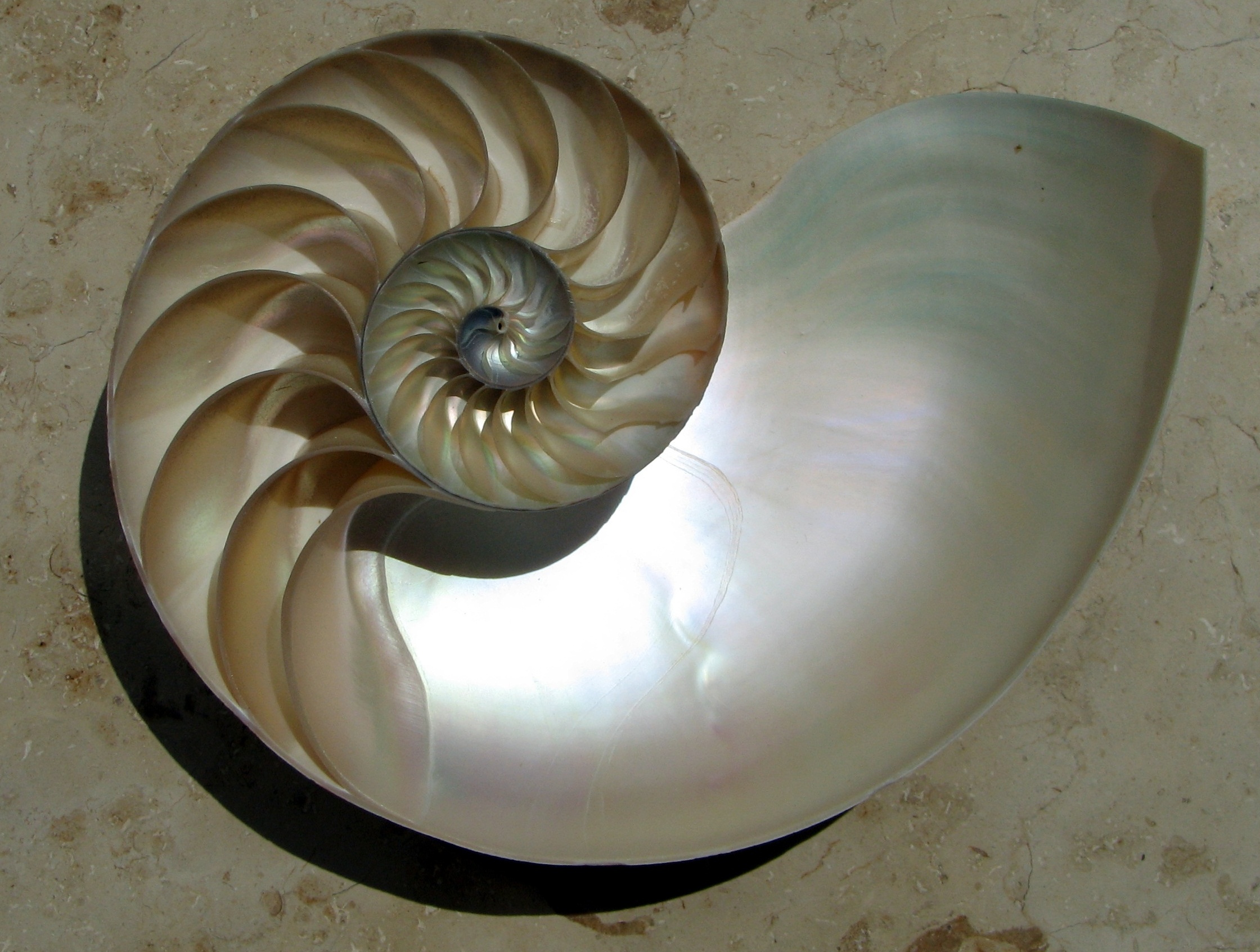 Nautilus shell — logarithmic spiral
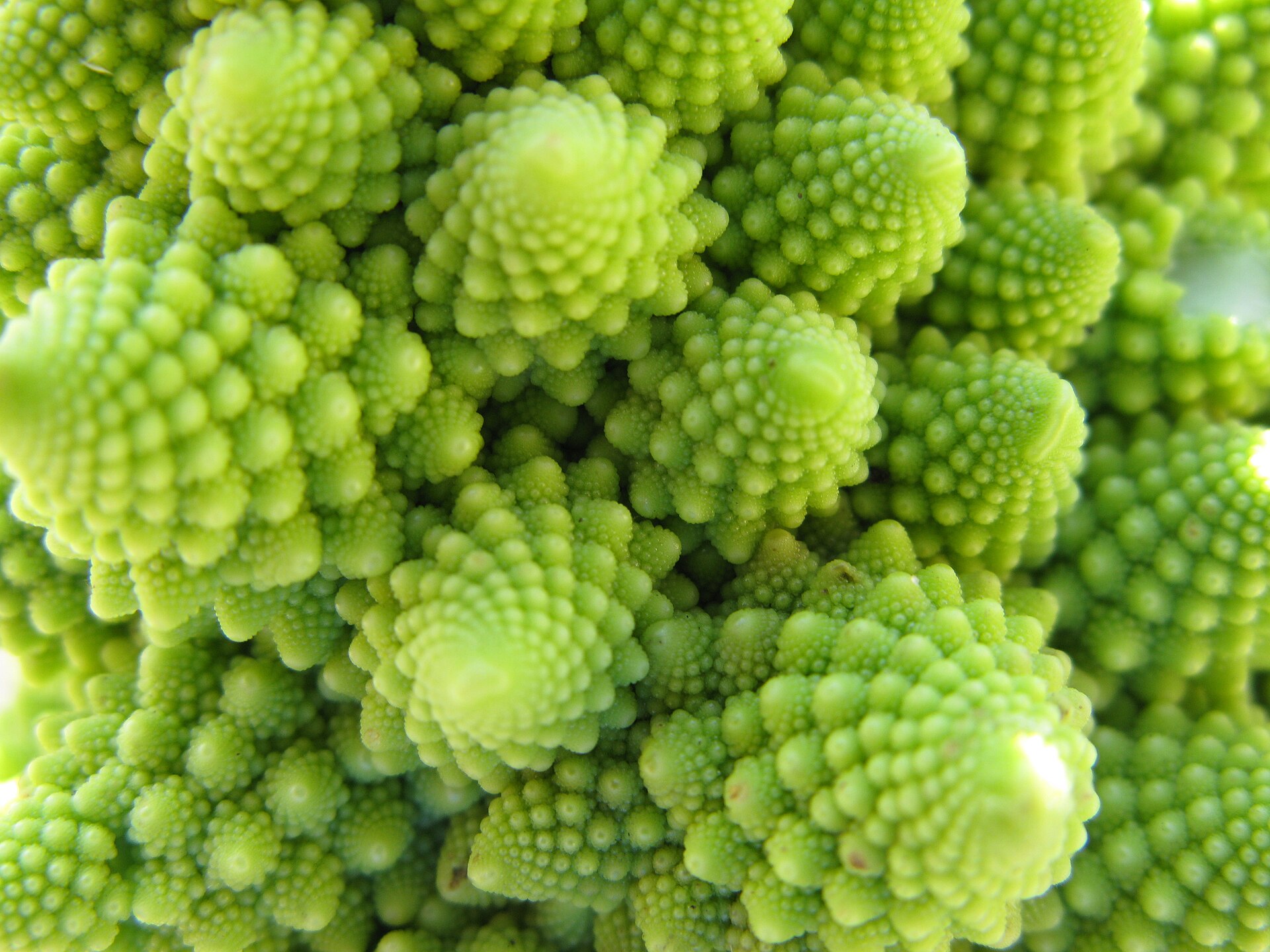 Romanesco broccoli — fractal Fibonacci
The Nautilus Shell — a chambered nautilus builds its shell one chamber at a time, each new chamber a fixed proportion larger than the last. The result is a logarithmic spiral in which every quarter-turn increases the radius by the same multiplicative factor. That part is genuinely true. What's commonly claimed beyond it isn't: the popular idea that this factor equals φ (1.618) has actually been tested. When mathematician Clement Falbo measured real shells at the California Academy of Sciences, and a later study measured eighty more from the Smithsonian collection, the average came out closer to 1.3 — not 1.618, and not particularly close to it. The nautilus is a real, beautiful logarithmic spiral. It just isn't a golden one.
Romanesco Broccoli — perhaps the most visually striking example of Fibonacci geometry in a living organism. Each floret is a smaller copy of the whole head, arranged in spirals that reliably count to consecutive Fibonacci numbers (13 and 21, or 21 and 34). This is phyllotaxis — the mathematical arrangement of growth points — and it maximises light exposure and minimises crowding at every scale simultaneously.
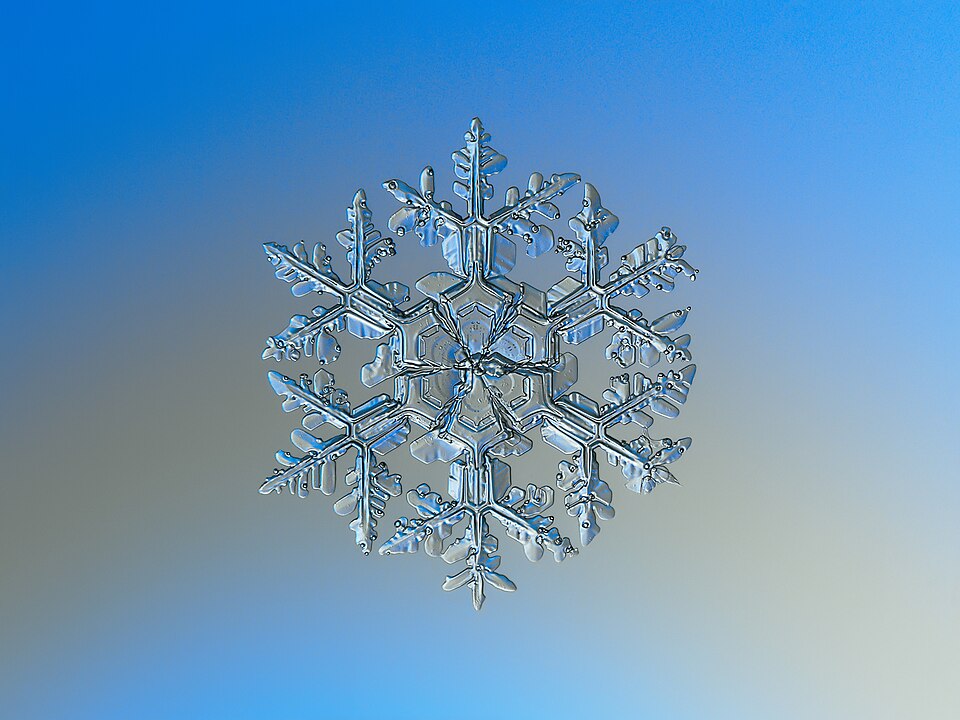 Snowflake — six-fold symmetry
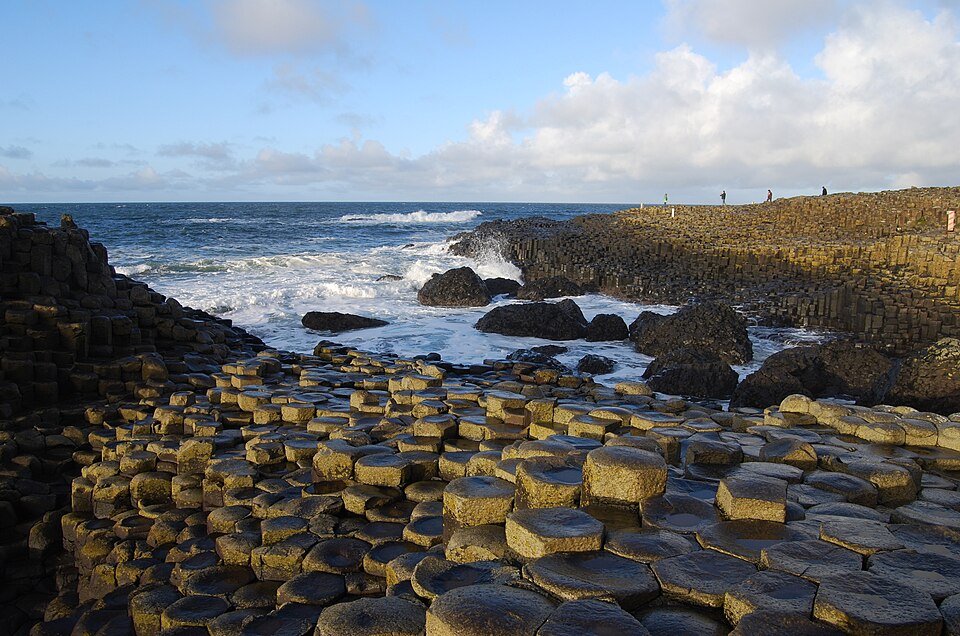 Giant's Causeway — hexagonal basalt
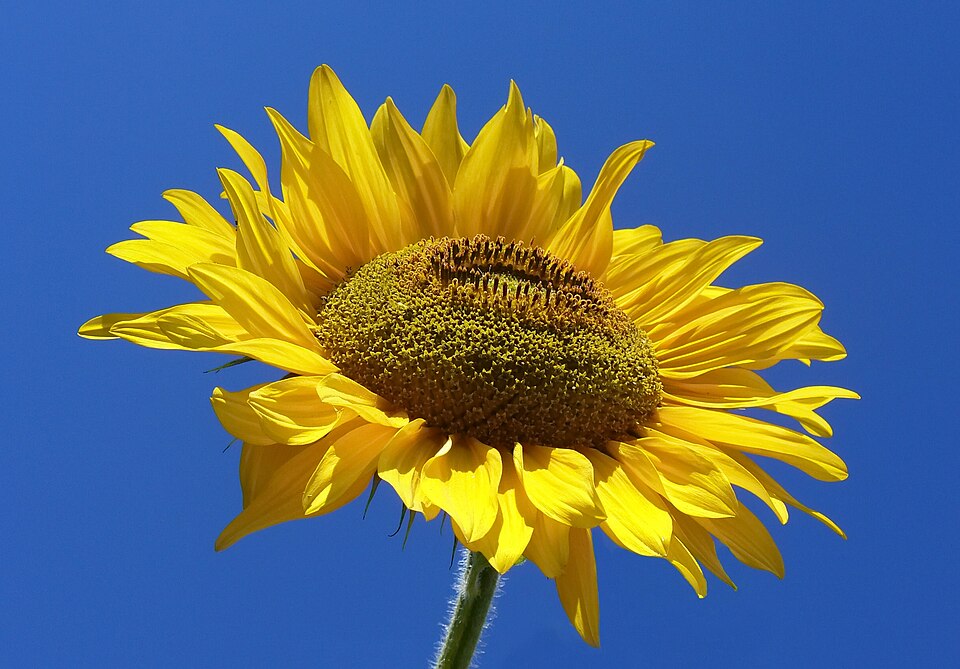 Sunflower — Fibonacci seed spirals
Hexagonal Symmetry — snowflakes have six-fold symmetry because water molecules form hexagonal hydrogen-bond networks at the molecular level, and that microscopic constraint propagates up to the visible crystal. The Giant's Causeway in Northern Ireland consists of roughly 40,000 basalt columns, most hexagonal, formed when ancient lava cooled and contracted. A hexagon minimises perimeter for a given area — it is the most efficient way to tile a flat surface, which is why bees use it for their comb and why basalt, cooling uniformly, cracks into hexagonal prisms rather than any other shape.
Sunflower Seeds — count the clockwise and anticlockwise spirals in a sunflower head and you will almost always find two consecutive Fibonacci numbers: commonly 34 and 55, or 55 and 89. This arrangement packs the maximum number of seeds into the available space with the minimum overlap. The mathematics was formalised by Helmut Vogel in 1979, who showed that the optimal packing angle is 360°/φ² ≈ 137.5° — the golden angle.
Many Circles
The Flower of Life — Hexagonal Order
Extend the Vesica construction: place a circle on each of the six intersection points of the first Vesica, keeping the same radius throughout. The result — a central circle surrounded by six — is the seed of the Flower of Life. Continue outward and the pattern tiles the plane perfectly, every centre equidistant from its six neighbours. This is a hexagonal lattice: the most efficient way to pack equal circles on a flat surface, proved mathematically in 1940 by László Fejes Tóth.
The Flower of Life pattern appears in the Temple of Osiris at Abydos, Egypt (estimated 6,000 years old), in the Forbidden City in Beijing, in medieval European cathedrals, and across dozens of cultures separated by oceans and millennia. Its independent re-discovery suggests it is less an invention than a recognition — human attention encountering the same mathematical reality from different starting points.
The Flower of Life — hexagonal lattice from equal circles
The Golden Proportion
Phi — The Ratio That Grows
Divide a line into two segments so that the ratio of the whole to the longer part equals the ratio of the longer part to the shorter. This single constraint produces one unique number: φ (phi).
φ = (1 + √5) / 2 ≈ 1.61803398874989...
φ² = φ + 1 (unique among all numbers)
1/φ = φ − 1
φ is irrational and unique: its square is exactly one more than itself, and its reciprocal is exactly one less. No other number behaves this way. This self-referential quality means φ naturally emerges wherever a structure grows by adding its previous state to itself — which is precisely what the Fibonacci sequence does.
Divide any Fibonacci term by its predecessor and the ratio approaches φ with increasing precision: 13/8 = 1.625, 34/21 = 1.619, 89/55 = 1.6181…. The sequence and the ratio are two aspects of the same underlying truth about growth. The dodecahedron — one of the five Platonic solids — has pentagonal faces whose diagonal-to-side ratio is exactly φ, making it the geometric bridge between the golden ratio and the five perfect solids.
Three Dimensions
The Five Platonic Solids — Why Only Five?
In three dimensions, something remarkable and finite occurs: there are exactly five regular solids. Not five out of many. Five total, and no others are possible. This was proved by Euclid in Book XIII of the Elements (c. 300 BCE) — one of the earliest impossibility proofs in the history of mathematics.
Dual of: itself
Dual of: octahedron
Dual of: cube
Dual of: dodecahedron
Dual of: icosahedron
In modern science the Platonic solids appear unexpectedly: the icosahedron in viral capsid structure (Crick and Watson, 1956); the cube in salt crystals; the tetrahedron in carbon bonding; and buckminsterfullerene (C₆₀, discovered 1985) — 60 carbon atoms arranged as a truncated icosahedron, the same pattern as a football.
Thirteen Circles, Five Solids
The Platonic Solids Within the Geometry
This lattice is formed by taking the 13 circles of the Fruit of Life — one at the centre, six at equal spacing around it, and six more at twice that distance — and drawing a straight line between every pair of centres. The resulting figure of overlapping lines is said in sacred geometry tradition to contain all five Platonic solids as projections within it.
Select each solid below to see its relationship to this lattice — and where the geometry meets its limits.
The five solids are not merely abstract — three occur naturally in crystal structures, one appears in microscopic marine life, and the fifth appears as an approximate form in minerals. The photographs below show each solid as it exists in the physical world.
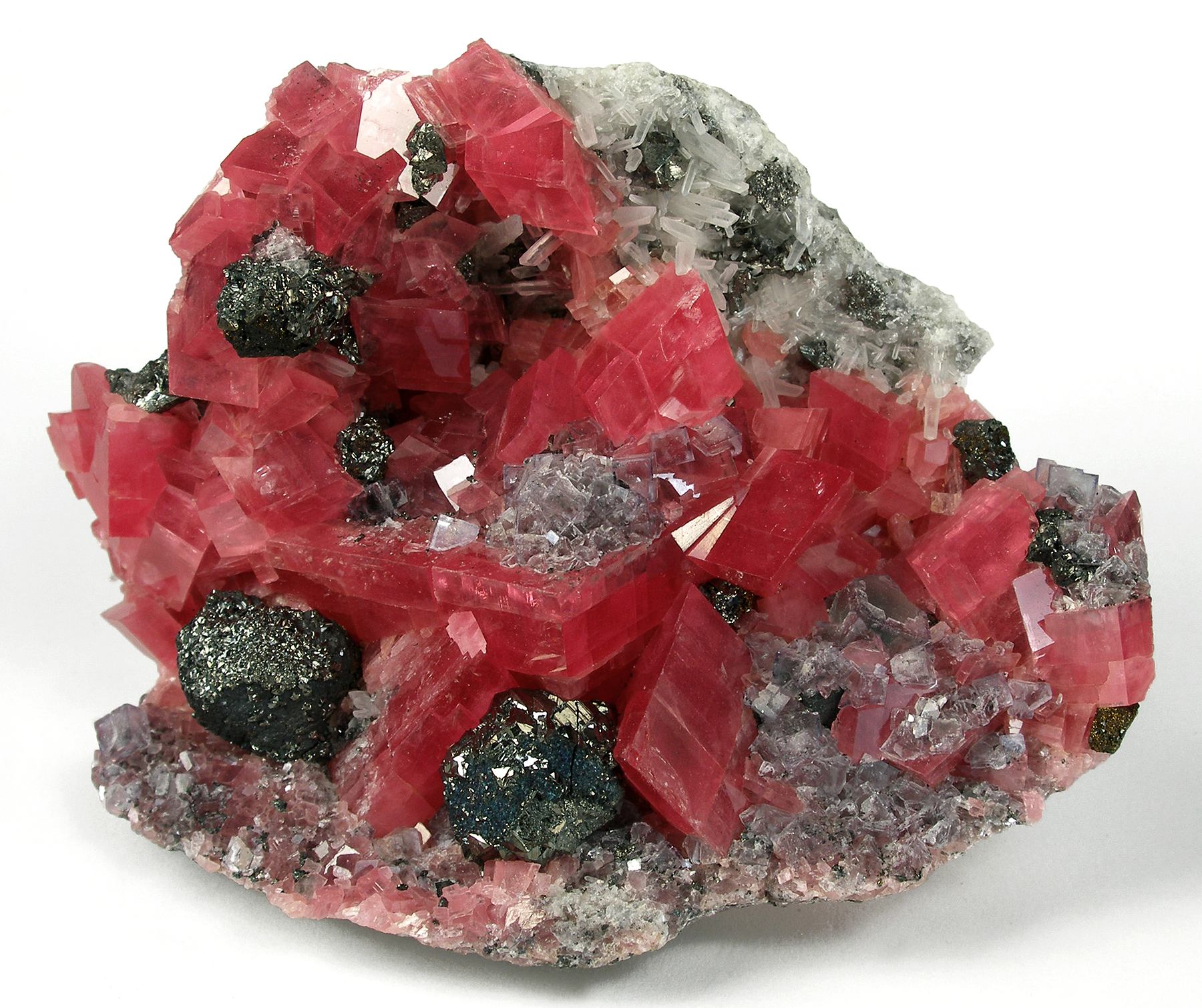
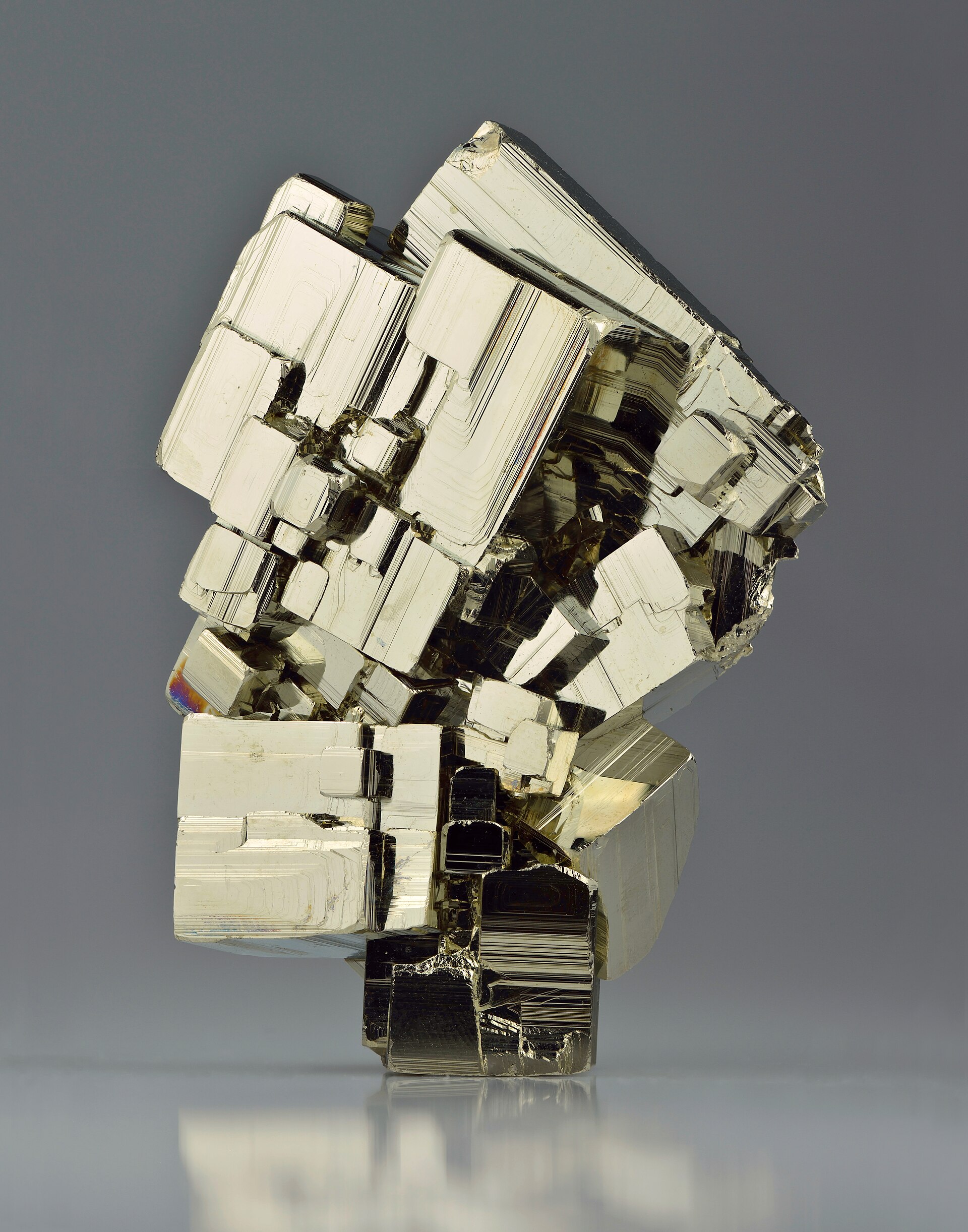
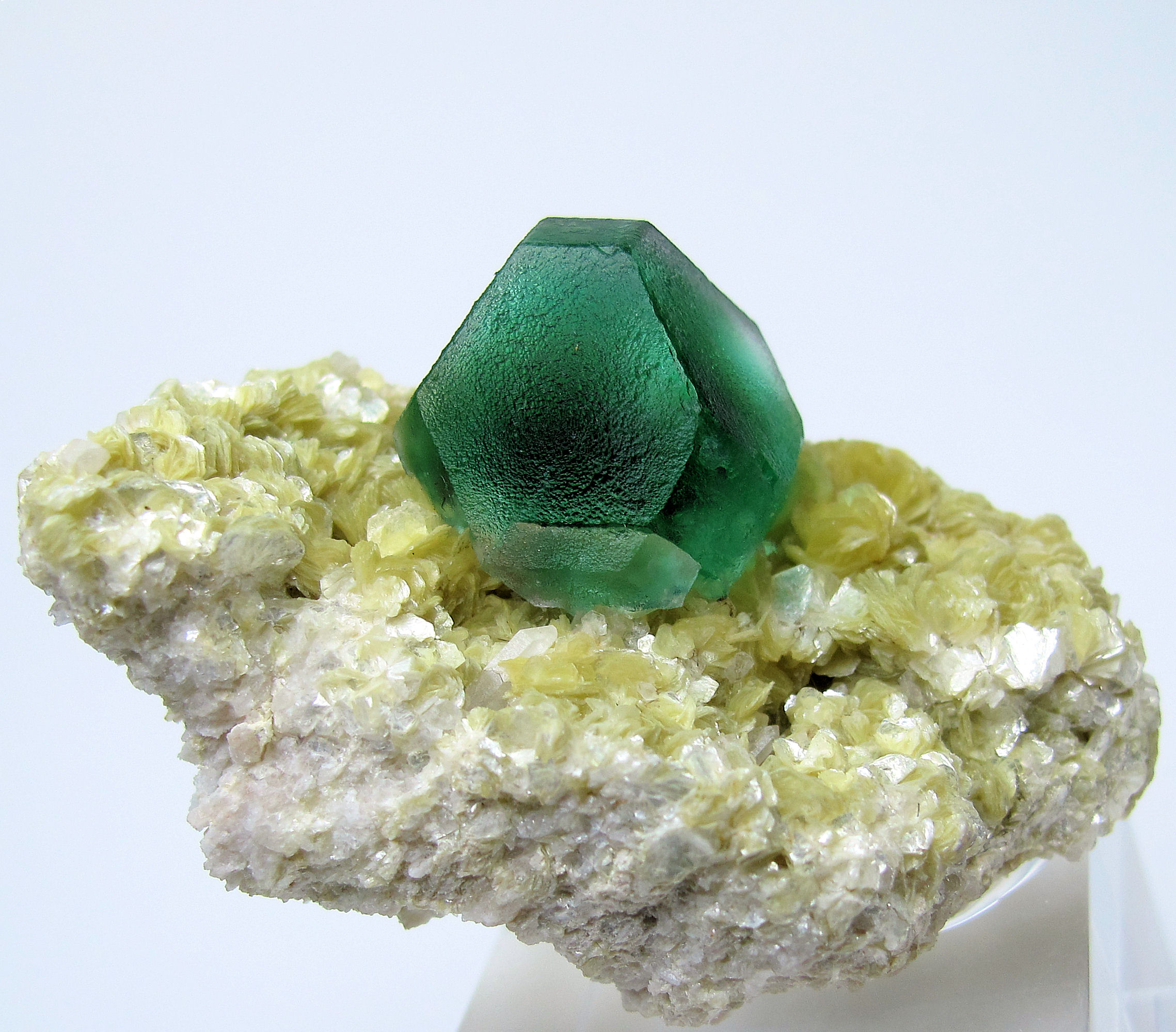
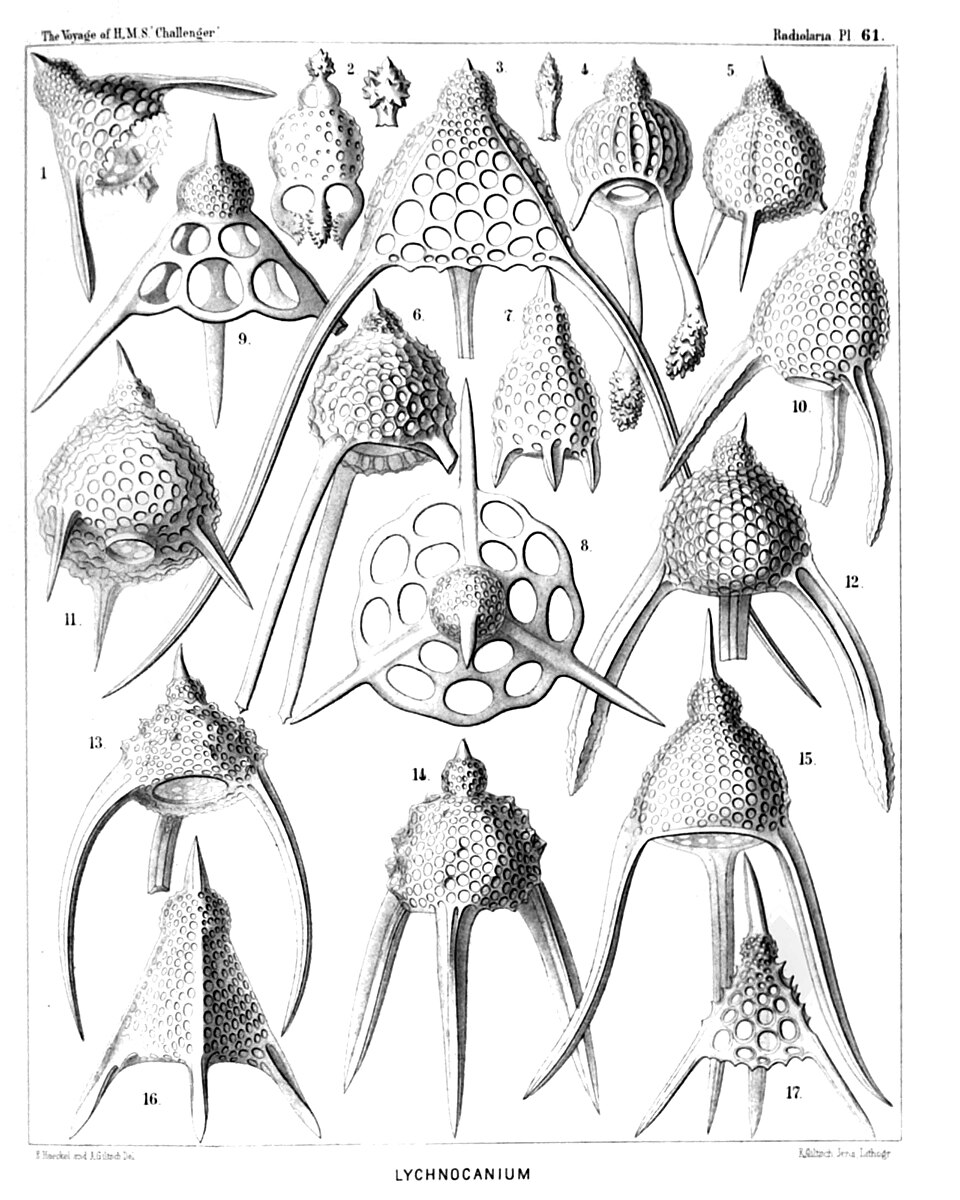
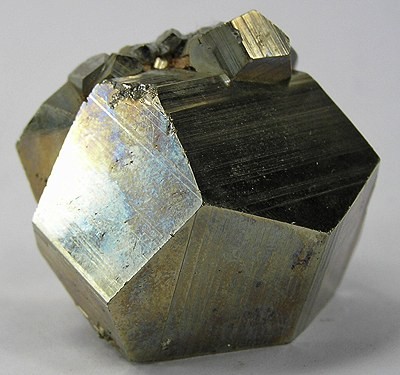
Photo sources (Wikimedia Commons): Tetrahedrite — search "Tetrahedrite crystal" · Pyrite cube — search "Cubic pyrite Navajun" · Fluorite octahedron — search "Fluorite octahedrons cubic pyrite" · Radiolaria — search "Ernst Haeckel Radiolaria plate" (public domain) · Pyritohedron — search "Pyritohedron" ·
Geometry Made Audible
The Geometry of Frequency
Sound is vibration — a wave of pressure moving through a medium. A pure tone is a sine wave, and a sine wave is the projection of circular motion onto a line. Every frequency you hear is, mathematically, a circle spinning at a particular rate.
The relationship between musical intervals and simple number ratios was discovered by Pythagoras using a plucked string: an octave is a 2:1 frequency ratio; a perfect fifth is 3:2; a perfect fourth is 4:3. These ratios reflect the physics of standing waves and the mathematics of resonance. Chladni patterns — sand scattered on a vibrating plate forming geometric figures at resonant frequencies — make this visible: sound is literally drawing geometry in matter.
Earth Geometry — Contested Territory
Geometric Patterns in the Earth Itself
What is well established: The Earth's tectonic plates have large-scale geometric structure as a direct consequence of spherical geometry — plate boundaries follow great circles (the largest possible circles on a sphere). Hotspot volcanism, where mantle plumes punch through the crust, shows some spatial regularity. Research published in peer-reviewed journals has found that large igneous provinces — the massive ancient eruptions that left continental flood basalts — cluster near two antipodal regions of the lower mantle, called Large Low Shear Velocity Provinces (LLSVPs), one beneath Africa and one beneath the Pacific. This clustering is real, measured seismically, and genuinely geometric.
Antipodal relationships: Roughly 75% of Earth's major hotspots are antipodally paired with subduction zones — the point diametrically opposite on the globe. Hawaii's antipode is the Kalahari in southern Africa. Iceland's is near the Kerguelen hotspot in the Indian Ocean. This is not mysticism — it reflects how mantle convection cells organise themselves in a sphere — but it is genuinely geometric and somewhat unexpected.
The icosahedral Earth hypothesis: In 1973 three Russian researchers (Goncharov, Morozov, and Makarov) proposed that Earth's major geological features — mountain ranges, mid-ocean ridges, hotspots, mineral deposits — align along a global grid combining icosahedral and dodecahedral geometry. They mapped 62 nodes and claimed significant correlations. This was later extended by American researchers Becker and Hagens into a 120-triangle Unified Vector Geometry (UVG) grid, which produced striking maps placing Giza, Stonehenge, Angkor Wat, and Machu Picchu near grid intersection points.
The ancient sacred site alignment question: A separate and somewhat better-supported observation is that many ancient megalithic and sacred sites — including Giza, Angkor Wat, Nazca, Easter Island, Stonehenge, and Ollantaytambo — lie close to a single great circle on the globe, within a few degrees of error. A 2016 analysis documented this alignment. Whether it reflects deliberate ancient global coordination, a shared response to geomagnetic or geological features, or selective pattern recognition in a large dataset remains genuinely unresolved.
What can be said without overreach: the Earth does exhibit real geometric structure at the scale of plate tectonics and mantle dynamics. The hypothesis that this structure maps onto Platonic solid geometry is intriguing and has motivated real research, but has not been confirmed. The question is alive — which is more honest than dismissing it entirely or accepting it uncritically.
References & Further Reading
- Plato, Timaeus (c. 360 BCE). The original source for the five Platonic solids and their elemental assignments. Project Gutenberg edition.
- Euclid, Elements, Book XIII (c. 300 BCE). The impossibility proof that exactly five regular convex polyhedra exist. Online edition with commentary.
- Lawlor, Robert. Sacred Geometry: Philosophy and Practice. Thames and Hudson, 1982.
- Livio, Mario. The Golden Ratio: The Story of Phi. Broadway Books, 2002. Rigorous treatment separating documented appearances of φ from folklore.
- Bartlett, Christopher. "Nautilus Spirals and the Meta-Golden Ratio Chi." Nexus Network Journal, Springer, 2018 (DOI: 10.1007/s00004-018-0419-3). Measured eighty Nautilus shells from the Smithsonian collection; found the average growth ratio is approximately 1.31, not the golden ratio, correcting a widely-repeated claim.
- Crick, F. H. C. & Watson, J. D. "Structure of Small Viruses." Nature 177 (1956): 473–475. First description of icosahedral symmetry in viral capsids.
- Torsvik, T. H. et al. "Pacific Plate Motion Change Caused the Hawaiian-Emperor Bend." Nature 433 (2004). On the clustering of large igneous provinces near LLSVPs.
- Vogel, H. "A Better Way to Construct the Sunflower Head." Mathematical Biosciences 44 (1979): 179–189. The mathematical basis for Fibonacci phyllotaxis.
- Leaves and sporangia developed in rare non-Fibonacci spirals in early leafy plants. Science, 2023 (DOI: 10.1126/science.adg4014). Fossil evidence that non-Fibonacci phyllotaxis is not a modern rarity but present from the earliest leafy plants.
- Goncharov, N., Morozov, V., & Makarov, V. "Is the Earth a Large Crystal?" Khimiya i Zhizn (Chemistry and Life) 3 (1973). The original icosahedral Earth grid paper.
- Encyclopaedia Britannica — Platonic solid.
Photography Credits
Nautilus shell cross-section: Chris 73 / Wikimedia Commons — CC BY-SA 2.5
Romanesco broccoli: Wikimedia Commons — CC BY-SA 3.0
Snowflake: Alexey Kljatov / Wikimedia Commons — CC BY-SA 4.0
Giant's Causeway: Wikimedia Commons — Public Domain
Sunflower: Wikimedia Commons — CC BY-SA 3.0
Acknowledgements
- Inspired by works from David Wilcock, Gregg Braden and Jason Shurka whose search for knowledge, truth and enlightenment has imbued a similar feeling amongst the developer.
- The camaraderie of the Maesteg Group whose collective wisdom is a joy to behold.
- The sounds of the Nature Healing Society who share the wonder of nature so well.